MINDFUL PAGES · LOOK INSIDE

Strategic Thinking: The Repository

Selected pages from the current manuscript. Final print layout may change.

Knowledge need: purpose and fit

Manuscript page 8
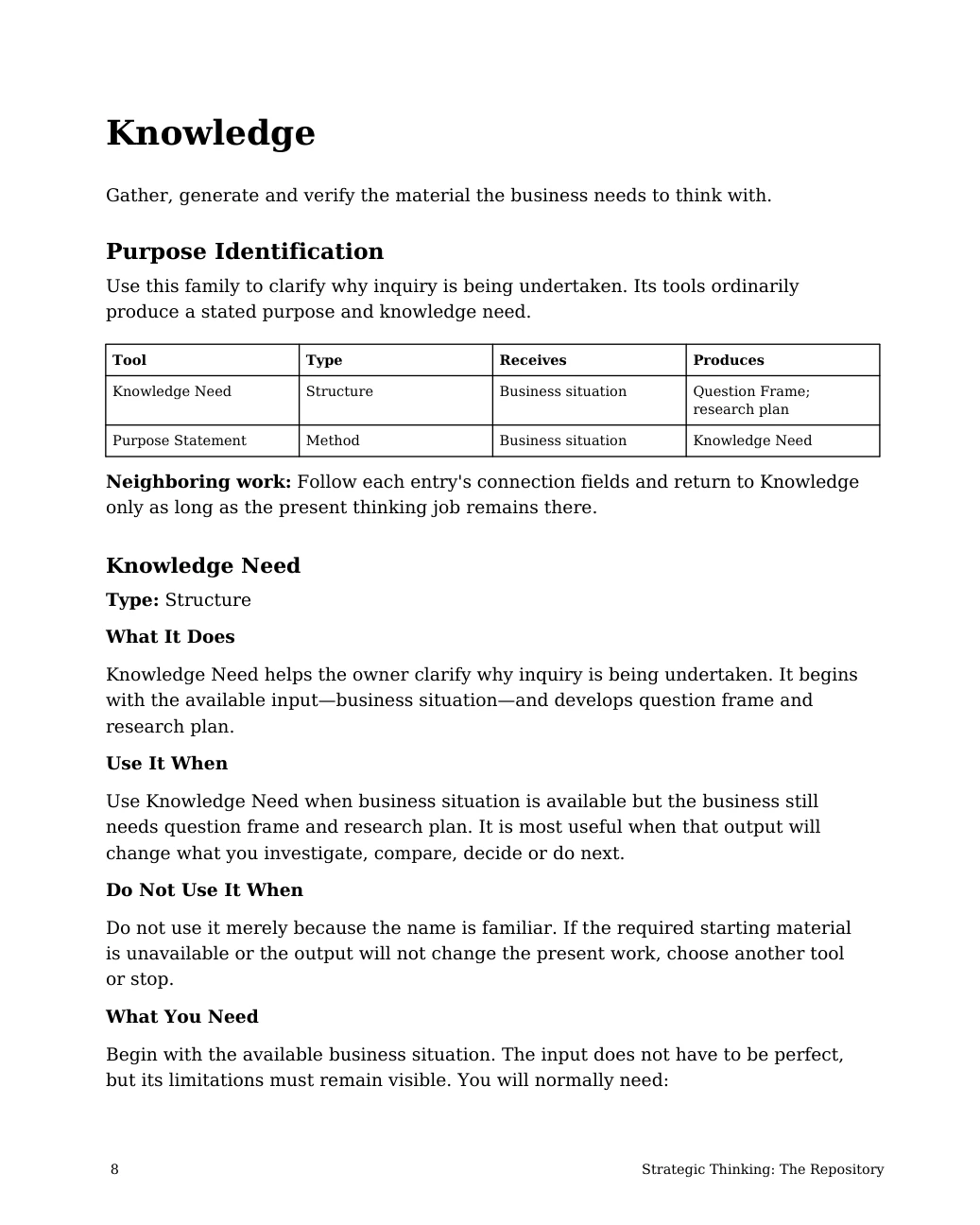
Knowledge need: purpose and fit — manuscript page 8
Read page text
Knowledge
Gather, generate and verify the material the business needs to think with.
Purpose Identification
Use this family to clarify why inquiry is being undertaken. Its tools ordinarily
produce a stated purpose and knowledge need.
Tool
Type
Receives
Produces
Knowledge Need
Structure
Business situation
Question Frame;
research plan
Purpose Statement
Method
Business situation
Knowledge Need
Neighboring work: Follow each entry's connection fields and return to Knowledge
only as long as the present thinking job remains there.
Knowledge Need
Type: Structure
What It Does
Knowledge Need helps the owner clarify why inquiry is being undertaken. It begins
with the available input—business situation—and develops question frame and
research plan.
Use It When
Use Knowledge Need when business situation is available but the business still
needs question frame and research plan. It is most useful when that output will
change what you investigate, compare, decide or do next.
Do Not Use It When
Do not use it merely because the name is familiar. If the required starting material
is unavailable or the output will not change the present work, choose another tool
or stop.
What You Need
Begin with the available business situation. The input does not have to be perfect,
but its limitations must remain visible. You will normally need:
8
Strategic Thinking: The Repository
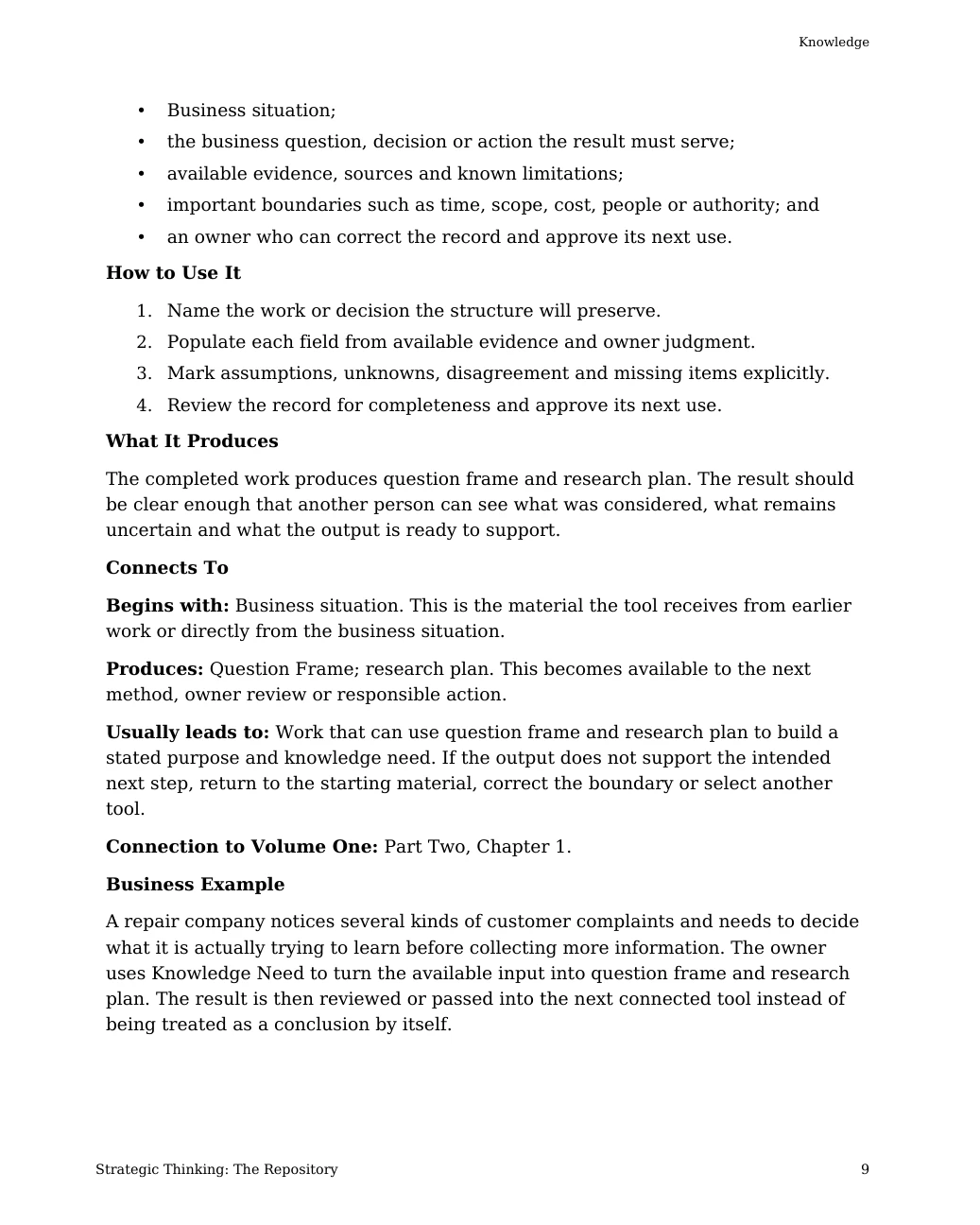
Knowledge need: steps and cautions

Manuscript page 9

Knowledge need: steps and cautions — manuscript page 9
Read page text
•
Business situation;
•
the business question, decision or action the result must serve;
•
available evidence, sources and known limitations;
•
important boundaries such as time, scope, cost, people or authority; and
•
an owner who can correct the record and approve its next use.
How to Use It
1.
Name the work or decision the structure will preserve.
2.
Populate each field from available evidence and owner judgment.
3.
Mark assumptions, unknowns, disagreement and missing items explicitly.
4.
Review the record for completeness and approve its next use.
What It Produces
The completed work produces question frame and research plan. The result should
be clear enough that another person can see what was considered, what remains
uncertain and what the output is ready to support.
Connects To
Begins with: Business situation. This is the material the tool receives from earlier
work or directly from the business situation.
Produces: Question Frame; research plan. This becomes available to the next
method, owner review or responsible action.
Usually leads to: Work that can use question frame and research plan to build a
stated purpose and knowledge need. If the output does not support the intended
next step, return to the starting material, correct the boundary or select another
tool.
Connection to Volume One: Part Two, Chapter 1.
Business Example
A repair company notices several kinds of customer complaints and needs to decide
what it is actually trying to learn before collecting more information. The owner
uses Knowledge Need to turn the available input into question frame and research
plan. The result is then reviewed or passed into the next connected tool instead of
being treated as a conclusion by itself.
Strategic Thinking: The Repository
9
Knowledge

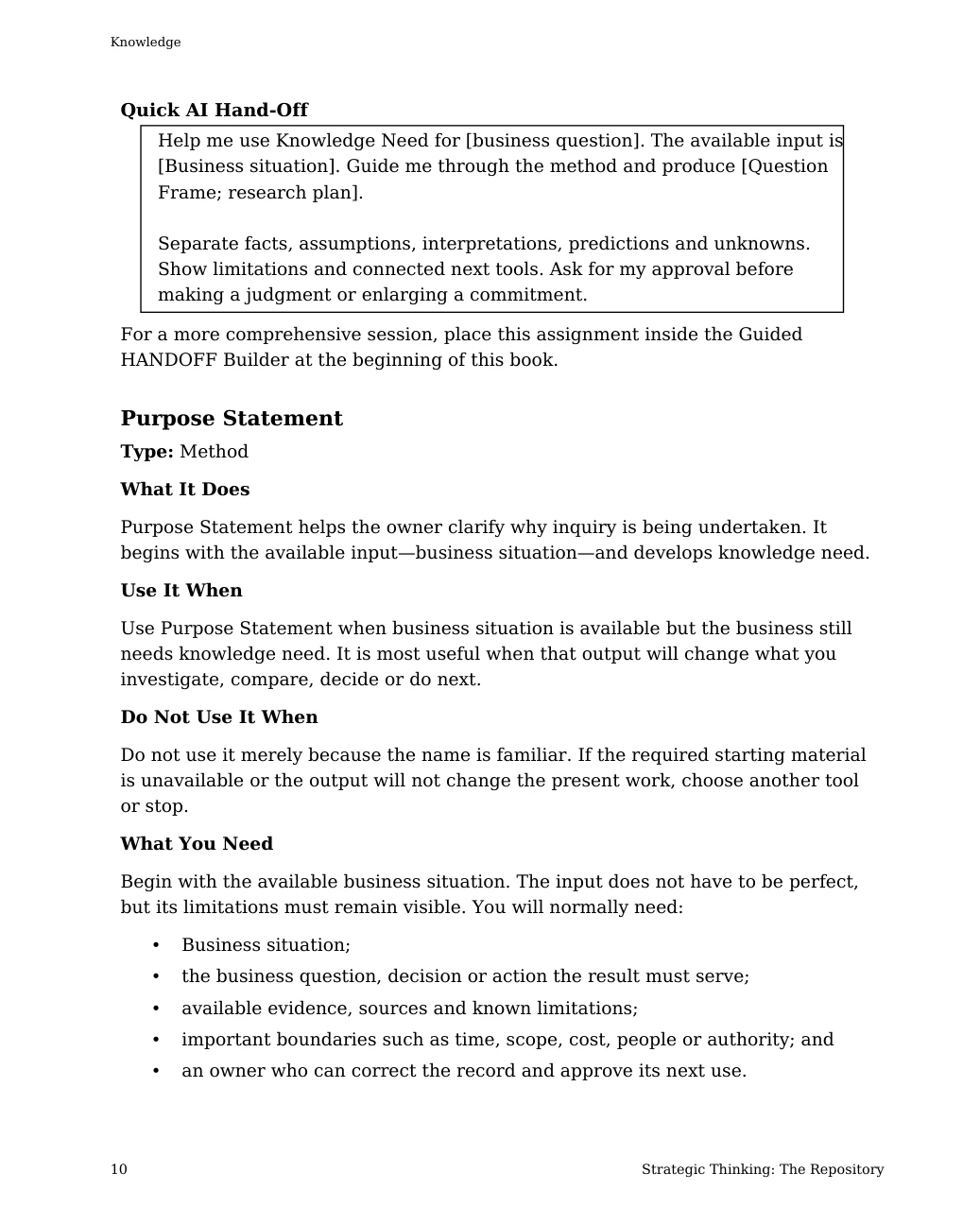
Knowledge need: AI hand-off

Manuscript page 10

Knowledge need: AI hand-off — manuscript page 10
Read page text
Quick AI Hand-Off
Help me use Knowledge Need for [business question]. The available input is
[Business situation]. Guide me through the method and produce [Question
Frame; research plan].
Separate facts, assumptions, interpretations, predictions and unknowns.
Show limitations and connected next tools. Ask for my approval before
making a judgment or enlarging a commitment.
For a more comprehensive session, place this assignment inside the Guided
HANDOFF Builder at the beginning of this book.
Purpose Statement
Type: Method
What It Does
Purpose Statement helps the owner clarify why inquiry is being undertaken. It
begins with the available input—business situation—and develops knowledge need.
Use It When
Use Purpose Statement when business situation is available but the business still
needs knowledge need. It is most useful when that output will change what you
investigate, compare, decide or do next.
Do Not Use It When
Do not use it merely because the name is familiar. If the required starting material
is unavailable or the output will not change the present work, choose another tool
or stop.
What You Need
Begin with the available business situation. The input does not have to be perfect,
but its limitations must remain visible. You will normally need:
•
Business situation;
•
the business question, decision or action the result must serve;
•
available evidence, sources and known limitations;
•
important boundaries such as time, scope, cost, people or authority; and
•
an owner who can correct the record and approve its next use.
10
Strategic Thinking: The Repository
Knowledge

Coming soon. Let me know when the books are available.

© 2026 Marc Young · Mindful Pages