Selected pages from the current manuscript. Final print layout may change.
Find the work you need
Manuscript page 7
Read page text
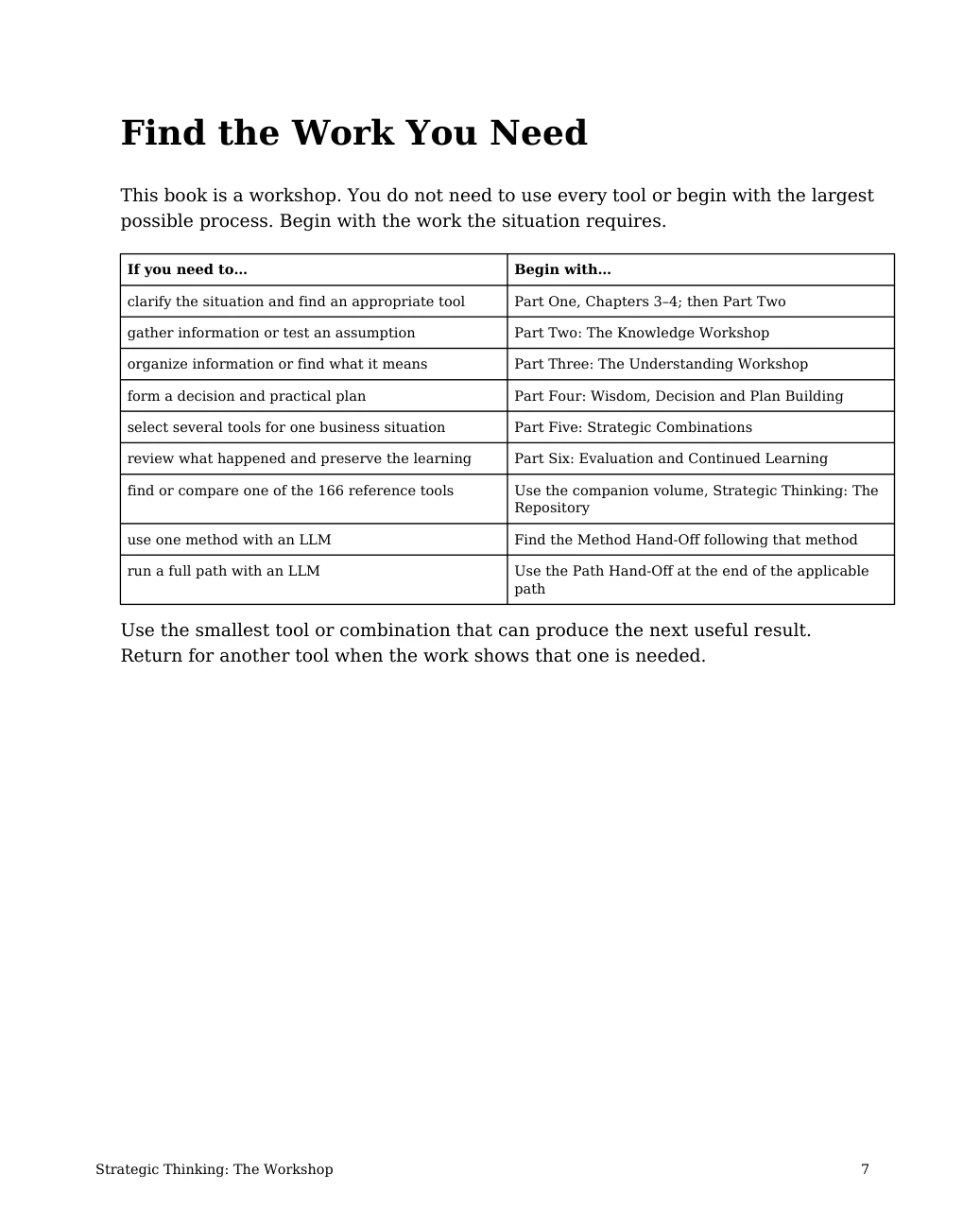
Find the Work You Need
This book is a workshop. You do not need to use every tool or begin with the largest
possible process. Begin with the work the situation requires.
If you need to…
Begin with…
clarify the situation and find an appropriate tool
Part One, Chapters 3–4; then Part Two
gather information or test an assumption
Part Two: The Knowledge Workshop
organize information or find what it means
Part Three: The Understanding Workshop
form a decision and practical plan
Part Four: Wisdom, Decision and Plan Building
select several tools for one business situation
Part Five: Strategic Combinations
review what happened and preserve the learning
Part Six: Evaluation and Continued Learning
find or compare one of the 166 reference tools
Use the companion volume, Strategic Thinking: The
Repository
use one method with an LLM
Find the Method Hand-Off following that method
run a full path with an LLM
Use the Path Hand-Off at the end of the applicable
path
Use the smallest tool or combination that can produce the next useful result.
Return for another tool when the work shows that one is needed.
Strategic Thinking: The Workshop
7
The four movements
Manuscript page 12
Read page text
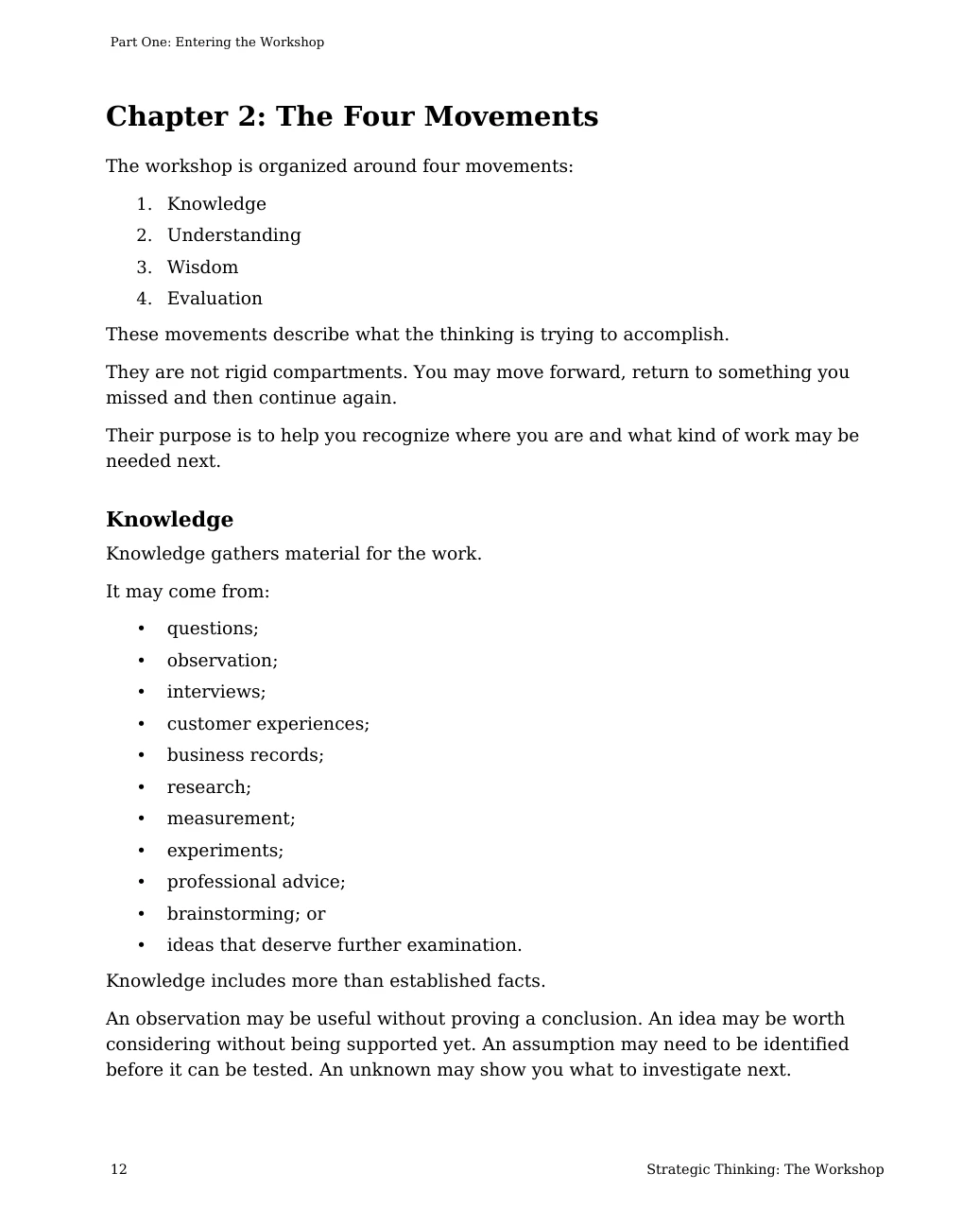
Chapter 2: The Four Movements
The workshop is organized around four movements:
1.
Knowledge
2.
Understanding
3.
Wisdom
4.
Evaluation
These movements describe what the thinking is trying to accomplish.
They are not rigid compartments. You may move forward, return to something you
missed and then continue again.
Their purpose is to help you recognize where you are and what kind of work may be
needed next.
Knowledge
Knowledge gathers material for the work.
It may come from:
•
questions;
•
observation;
•
interviews;
•
customer experiences;
•
business records;
•
research;
•
measurement;
•
experiments;
•
professional advice;
•
brainstorming; or
•
ideas that deserve further examination.
Knowledge includes more than established facts.
An observation may be useful without proving a conclusion. An idea may be worth
considering without being supported yet. An assumption may need to be identified
before it can be tested. An unknown may show you what to investigate next.
12
Strategic Thinking: The Workshop
Part One: Entering the Workshop
Finding the right tool
Manuscript page 16
Read page text
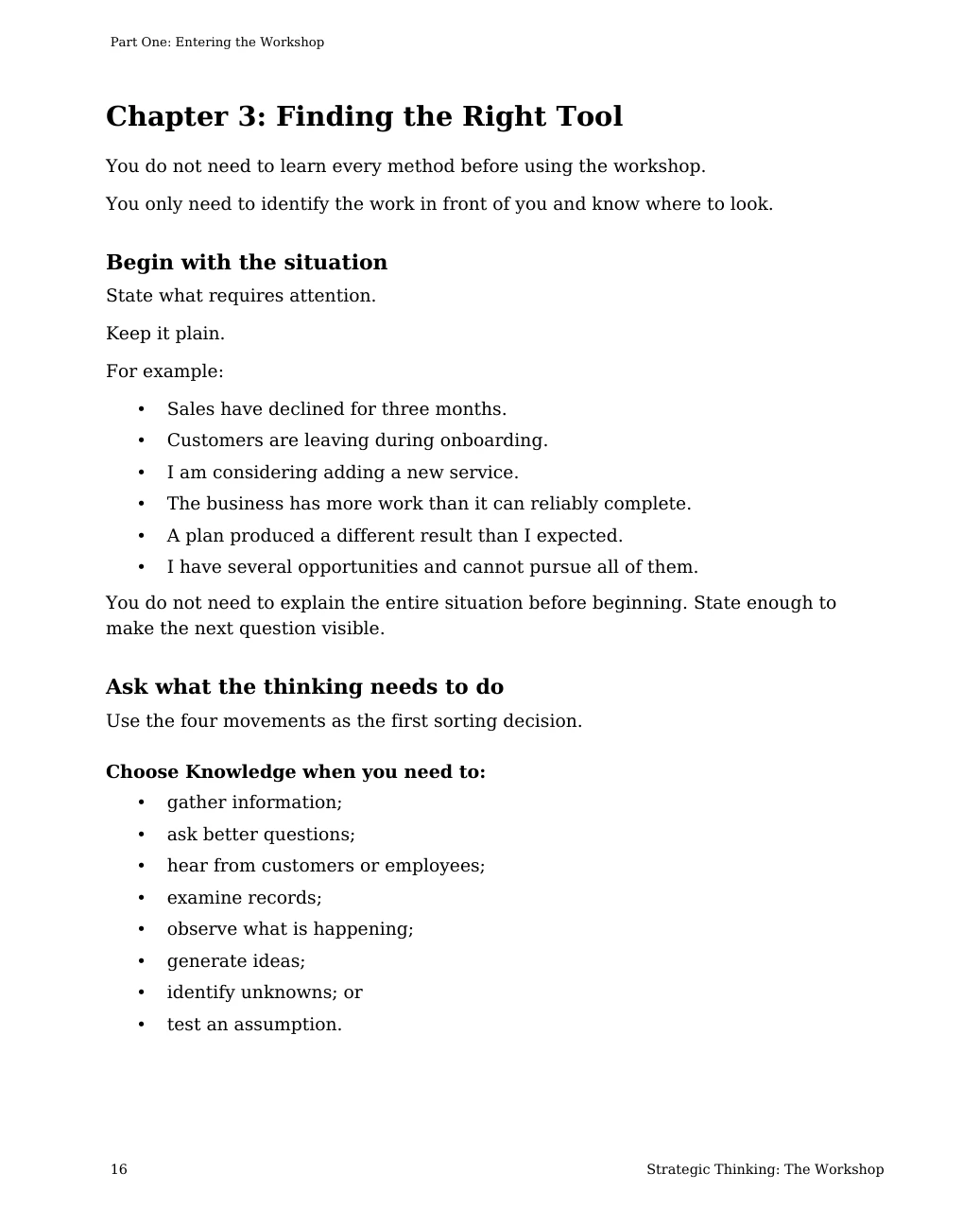
Chapter 3: Finding the Right Tool
You do not need to learn every method before using the workshop.
You only need to identify the work in front of you and know where to look.
Begin with the situation
State what requires attention.
Keep it plain.
For example:
•
Sales have declined for three months.
•
Customers are leaving during onboarding.
•
I am considering adding a new service.
•
The business has more work than it can reliably complete.
•
A plan produced a different result than I expected.
•
I have several opportunities and cannot pursue all of them.
You do not need to explain the entire situation before beginning. State enough to
make the next question visible.
Ask what the thinking needs to do
Use the four movements as the first sorting decision.
Choose Knowledge when you need to:
•
gather information;
•
ask better questions;
•
hear from customers or employees;
•
examine records;
•
observe what is happening;
•
generate ideas;
•
identify unknowns; or
•
test an assumption.
16
Strategic Thinking: The Workshop
Part One: Entering the Workshop